

I want to acknowledge upfront that this article was inspired by a recent podcast from Craig Groeschel. He briefly touched on a concept that immediately captured my attention, and I felt it deserved deeper exploration. What follows is my attempt to unpack that idea more fully.
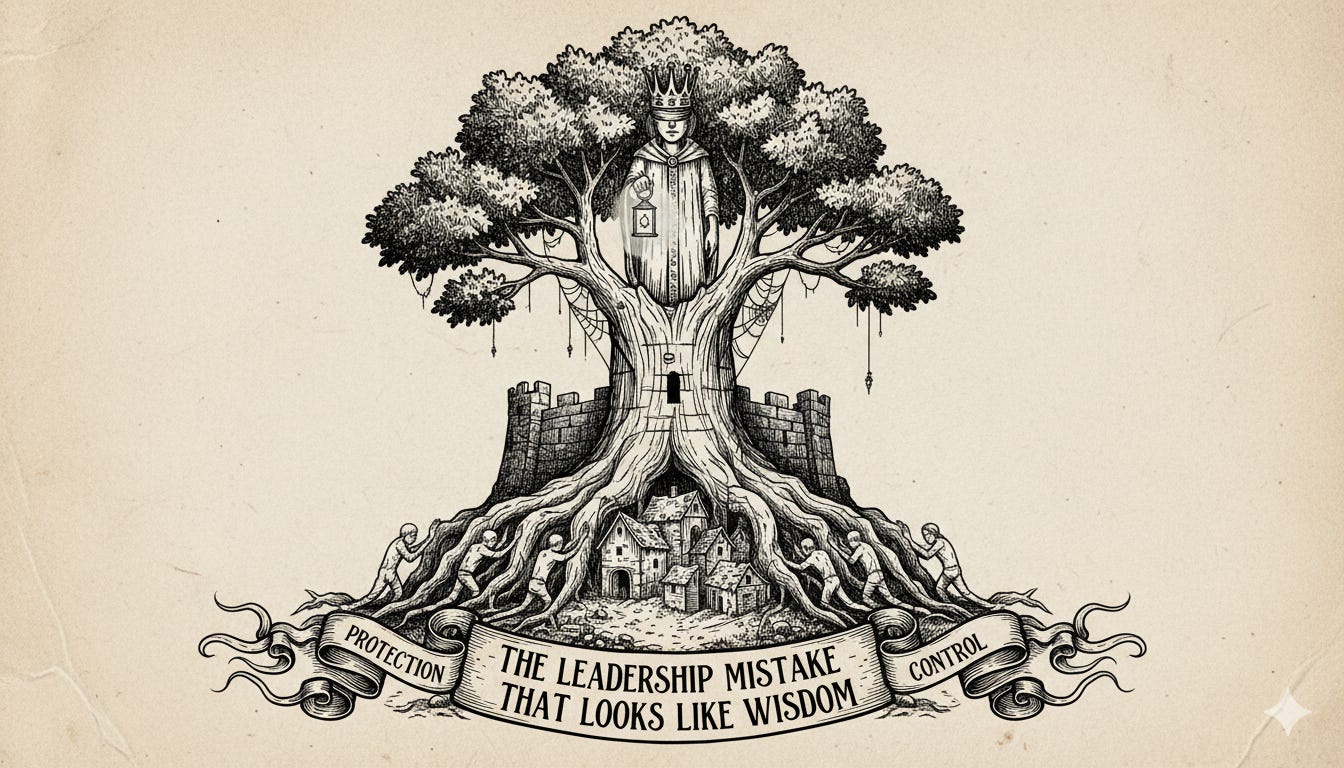
You’ve built a team. You’ve delegated responsibilities. You’ve stepped back to work on the organization instead of in it.
This is what good leadership looks like.
But here’s what nobody tells you about delegation: the better you get at it, the more critical your interventions become.
I’ve watched leaders make the same mistake repeatedly. They confuse delegation with disappearing.
They step back so far that they miss the moments when their direct involvement becomes essential. They convince themselves that any intervention would be micromanagement.
And slowly, everything they built starts to drift.
The organizations that thrive long-term are led by people who understand a counterintuitive truth. Knowing when to step back in matters just as much as knowing when to step back.
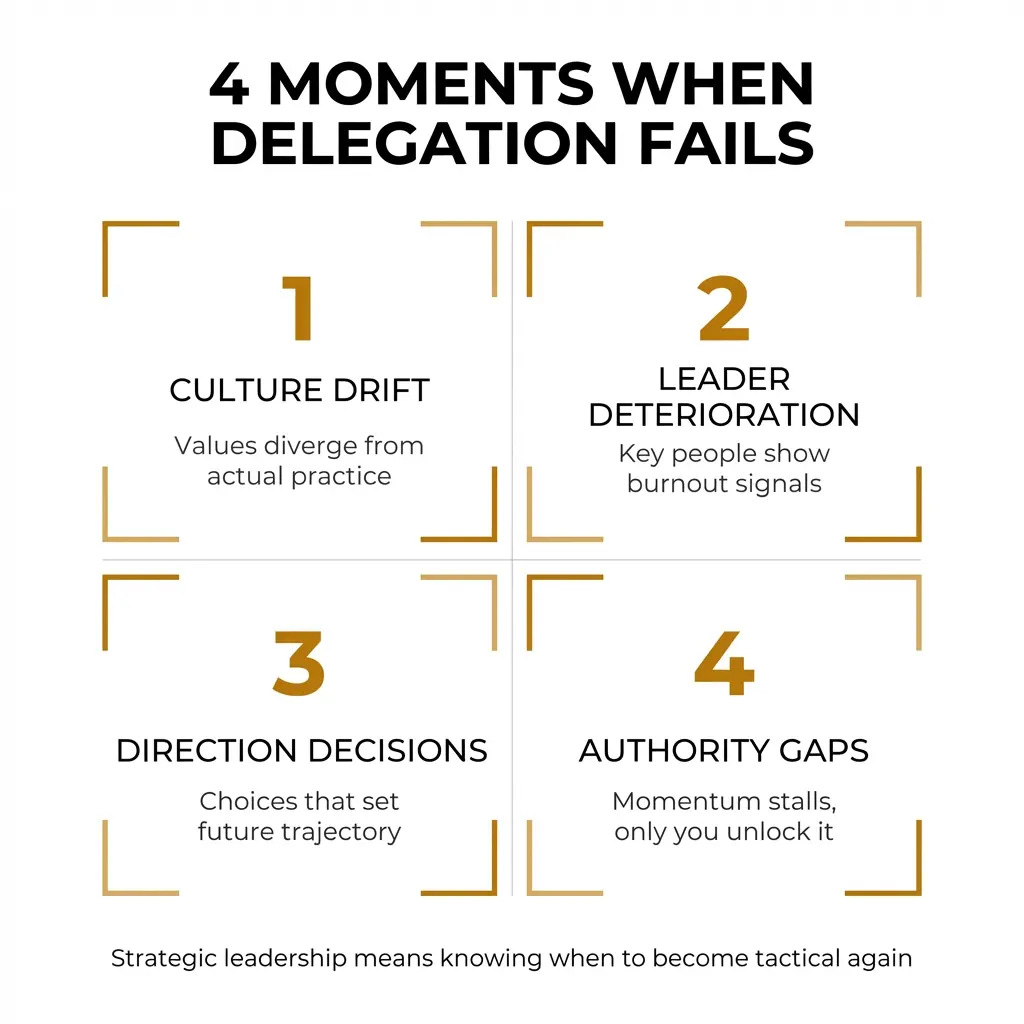
There are four crucial moments, I’ve learned myself, when you must stop working on your organization and step directly into it. Miss these moments, and you’ll watch what you’ve built become something you never intended.
The Rhythm of Effective Leadership
Scripture gives us a remarkable window into this tension through the life of Nehemiah.
Nehemiah was a strategic leader by any definition. He cast vision for rebuilding Jerusalem’s walls. He organized teams, delegated responsibilities, and created systems for sustained progress. He understood that he couldn’t lay every brick himself.
But watch what happens when opposition arises:
“When our enemies heard that we were aware of their plot and that God had frustrated it, we all returned to the wall, each to our own work. From that day on, half of my men did the work, while the other half were equipped with spears, shields, bows and armor.”
— Nehemiah 4:15-16 NIV
Nehemiah didn’t stay in his strategic position when the threat emerged. He stepped directly into the situation. He reorganized. He stood with his people. He placed himself exactly where his presence was needed most.
Then, once the crisis passed and the new structure was established, he stepped back again.
This rhythm defines effective leadership: strategic distance that is met by intentional intervention.
The question isn’t whether you should delegate. You should. The question is whether you can recognize the moments when delegation must pause and your direct involvement becomes the only path forward.
4 Crucial Moments When a Leader Must Step Into the Action
#1: When Culture Starts to Drift
Your organizational culture is your most valuable and most fragile asset.
Culture isn’t what you print on posters or recite in team meetings. Culture is the pattern of behaviors you tolerate and the standards you reinforce through your attention. It’s what actually happens when you’re not in the room.
Here’s what makes culture dangerous: it drifts quietly.
Someone cuts a corner to meet a deadline.
A standard slips because addressing it feels uncomfortable.
A value gets compromised in the name of efficiency.
These moments seem small in isolation. But left unaddressed, they compound into the new normal. They redefine who you actually are as an organization, regardless of what your mission statement claims.
When you see culture drift, you must step in directly.
I remember working with a remodeling company a few years back where the founder had built something really great. The company was known throughout Ohio for transparency and genuine care for employees. These weren’t just talking points. They were lived realities that attracted top talent and created fierce loyalty.
Then the company grew. The founder stepped into a more strategic role. He hired excellent leaders to manage day-to-day operations.
Within eighteen months, the culture had shifted. That same transparency became selective and care became transactional.
The founder noticed it during a routine visit to a regional office. The energy was different. The conversations were guarded. Something essential had eroded.
He had to step back in. Not permanently. But to reset the foundation that made the organization worth building in the first place. His direct intervention sent a message that no memo could communicate: this matters enough for me to stop everything else and address it personally.
Nehemiah faced this same moment. When he returned to Jerusalem after an absence and discovered that the people had compromised their commitments, he didn’t delegate the correction. He stepped in directly, confronted the issues personally, and reestablished the standards that defined their identity as God’s people.
Your team can maintain culture. Only you can reset it when it starts to erode.
#2: When Key Leaders Show Signs of Deterioration
Your key leaders are infrastructure, not simply personnel.
When a critical team member starts showing signs of burnout, moral compromise, relational breakdown, or capacity overload, you’re not facing a human resources issue. You’re facing a structural threat to your organization’s ability to execute its mission.
Most leaders treat key leader health as something to delegate. They assume someone else can handle it. They hope a peer will notice and intervene. They’re uncomfortable with personal conversations that feel invasive.
This is a serious error with serious consequences.
When a key leader shows signs of deteriorating health, you must step in directly.
I’ve watched too many organizations lose leaders because the senior leader stayed too removed. They noticed the warning signs. They hoped someone else would address the situation. They assumed the struggling leader would reach out if things became serious.
By the time they finally stepped in, the damage was done. The leader was gone, the team was demoralized, and the recovery took a long time.
Your direct intervention accomplishes what no delegated conversation can achieve. It demonstrates that you value the person beyond their tasks and it signals to the entire organization that leadership health is a non-negotiable priority.
The warning signs are often visible long before the crisis hits.
Consistent patterns of excessive hours.
Withdrawal from relationships and team interaction.
Decline in decision-making quality.
Increased irritability or emotional ups and downs.
Neglect of personal health or family responsibilities.
Loss of passion for work that previously energized them.
And the list goes on and on.
When you observe these indicators, schedule a direct conversation within 48 hours.
Don’t delegate this. Don’t wait for your next scheduled meeting. Your immediate attention communicates both urgency and care simultaneously.
The Apostle Paul modeled this priority throughout his ministry.
Despite the strategic demands of church planting across the Roman empire, he regularly stepped into the personal struggles of key leaders like Timothy. His letters reveal a leader who understood that organizational health flows directly from leadership health.
#3: When Decisions Affect the Future Direction
You’ve empowered your team to make decisions. This is healthy leadership.
But some decisions carry implications that extend far beyond their immediate intentions. They set new standards. They establish direction. They commit resources and more.
These decisions require your direct involvement.
The challenge is that strategic decisions don’t always announce themselves as strategic.
They often appear tactical on the surface. A new initiative. A partnership opportunity. A resource allocation. A process change.
Your team might not recognize the strategic impact because they lack your vantage point. They’re making the best decision based on the information and perspective available to them. This is exactly what you’ve trained them to do.
But this is exactly where your strategic position must become tactical. You must step into the decision-making process early enough to provide context without undermining your team’s authority.
One church I worked with had expanded into seven new program areas over 2 years. Each expansion made sense at the strategic level. Each addressed a genuine need. Each had a champion on the leadership team who believed deeply in the work.
And so, the pastor trusted the team.
In about 6 months, the organization had become something fundamentally different from its original vision. The mission statement remained unchanged, but the actual work no longer looked like it did a year ago. That pastor spent the next two years refocusing what had drifted so far from the original calling and is still working on it today.
A decision affects future direction when it establishes a pattern that will be difficult to reverse.
Create clarity with your team about which decisions require your involvement. This isn’t about control. It’s about ensuring strategic coherence across every level of your organization.
#4: When Momentum Stalls Due to Authority Gaps
Let me give some more clarity to this one. You’ve launched a strategic initiative. Your team is executing well. You see progress. And then…
Then everything stops.
Not because of unclear vision. Not because of insufficient effort. But because someone needed authority they didn’t have to move forward.
When momentum stalls due to authority gaps, you must step in proactively.
This looks different from micromanagement.
Micromanagement inserts your authority where it isn’t needed. Strategic authority recognizes where only your position can remove obstacles or create pathways forward.
The leaders who execute strategic initiatives most effectively anticipate authority gaps before they become bottlenecks.
They don’t wait for their team to request help. They proactively identify moments where their direct involvement will accelerate progress.
This might look like making a phone call to open a door. Providing approval for a decision that’s been delayed. Offering cover for a controversial but necessary action. Allocating resources that only you can authorize.
The key is timing.
Authority gaps that persist become momentum killers. Your team loses confidence. Stakeholders lose patience and opportunities quickly close.
What could have been resolved with a single intervention now requires extensive recovery work.
Nehemiah demonstrated this principle when he personally intervened to address the economic injustice that was stalling the rebuilding project. The workers needed authority they didn’t possess to confront the nobles and officials who were exploiting them.
Nehemiah stepped in, exercised his unique authority, and momentum resumed immediately.
Your goal is removing yourself from routine decisions while remaining immediately available for authority-needed moments. This requires regular communication with your team and a willingness to act quickly when the moment arrives.
The Calibration Question
These four moments define the boundaries of healthy delegation. They’re not exhaustive, but they cover the key points I’ve seen leaders miss most often.
The question you must answer regularly is this: Am I too far removed from these four areas, or am I too involved in areas that don’t require my direct attention?
Most leaders err in one direction or the other. They’re either too hands on across the board, inserting themselves into decisions their team should own. Or they’re too removed to notice when intervention becomes necessary, missing the warning signs until recovery from it becomes painful.
The goal is a healthy calibration.
Strategically distant enough that your team experiences genuine autonomy but close enough that you can recognize and respond to these four moments before they become crises.
Making This Practical
Understanding these four moments is one thing. Building systems to recognize them is another. Here’s how to put this framework into action this week.
Conduct a 30-minute assessment of each area. Block time on your calendar before Friday. Walk through each of the four moments with a simple question: What am I missing?
Write down anything that surfaces. Culture drift often hides in plain sight. Key leader deterioration reveals itself through patterns you’ve normalized. Strategic decisions may have already been made without your awareness. Authority gaps might be stalling initiatives right now while your team hesitates to ask for help.Schedule one conversation you’ve been avoiding. Every leader reading this has at least one. Maybe it’s the key leader showing warning signs. Maybe it’s the team member making decisions that are quietly shifting your organization’s direction. Maybe it’s the direct report who needs authority they don’t have but hasn’t felt permission to ask.
Identify that conversation and put it on your calendar for this week. Not next week. This week.Create a monthly rhythm to revisit these four areas. The leaders who navigate these moments well don’t rely on intuition alone. They build regular checkpoints into their schedule. Once a month, ask yourself four questions: Where is culture drifting? Which key leaders need my direct attention? What decisions are being made that affect our future direction? Where is momentum stalling because someone needs authority they don’t have?
Write these questions somewhere you’ll see them. Make the review non-negotiable.
The strength of your delegation is ultimately measured by your interventions.
When you know exactly when to step back in, you create the conditions for sustainable growth and lasting impact.
Your team doesn’t need you to do their work. They need you to recognize the moments when only you can do what needs to be done.
Those moments are here. The question is whether you’re positioned to see them and willing to act when they arrive.
Keep leading!
— Jared
If this framework helped clarify your approach to leadership and delegation, I’d be grateful if you shared this newsletter with another leader who needs it. The best way to grow this community is through your personal recommendation. Forward this to someone who came to mind while reading, and let’s help more leaders build organizations that last.